


 6 minutes
 Share
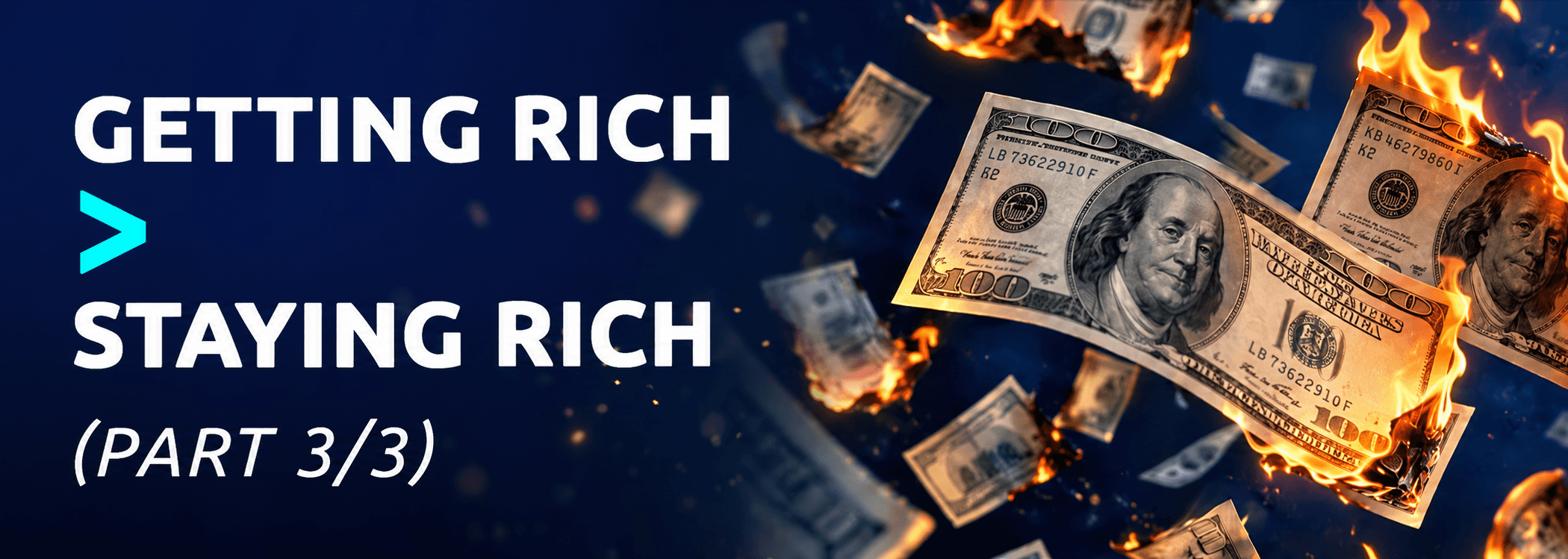
Getting Rich Is Easier Than Staying Rich: Why Most People Lose Their Money
Getting rich is difficult but keeping wealth can be even harder. Some people spend decades building a business, growing an investment portfolio, or advancing through a high-paying career, only to lose a large part of what they accumulated in a surprisingly short period. The reason is simple: the skills that help you build wealth are not always the same skills that help you protect it.
As Morgan Housel explains in The Psychology of Money, becoming wealthy often requires optimism, ambition, and risk-taking. Staying wealthy requires something very different: humility, patience, caution, and the constant awareness that things can go wrong.
Key Takeaways
- Building wealth and preserving wealth require different financial skills.
- Success can create dangerous levels of overconfidence.
- One large loss can erase years of financial progress.
- Debt and leverage can magnify both gains and losses.
- Cash reserves and diversification can protect against unexpected events.
- Long-term financial survival matters more than maximizing every possible return.
- The goal is not to avoid every loss-it is to avoid financial ruin.
How Wealthy People Lose Money
Wealth is often lost in surprisingly predictable ways.
The details change, but the patterns remain similar:
- excessive leverage;
- concentrated investments;
- lifestyle inflation;
- speculative schemes;
- overconfidence;
- poor liquidity;
- excessive fixed expenses;
- refusal to reduce risk after success.
They Keep Playing Like They Still Have Nothing to Lose
A strategy that makes sense when someone has little capital may become inappropriate after they have already achieved financial independence.
If you have nothing, taking a calculated risk may be necessary.
If you already have enough, the same risk may be unnecessary.
The mistake is failing to recognize when the game has changed.
They Confuse a Bull Market With Personal Genius
Strong markets can make almost everyone look intelligent.
When asset prices rise for years, risky decisions are often rewarded. That can create the illusion that skill alone produced the result.
When market conditions eventually change, the same strategy may perform very differently.
They Upgrade Their Lifestyle Until Wealth Becomes Fragile
Wealth can also disappear through spending rather than investing.
A large house, expensive vehicles, private memberships, luxury travel, and other recurring costs can create extremely high fixed expenses.
The person may still have substantial assets, but their lifestyle requires continuous high income.
That is not complete financial freedom.
It is a more expensive form of financial dependence.
7 Rules for Staying Rich Once You Build Wealth
Building wealth is only the first stage. Preserving it requires a different set of rules.
Rule #1 - Never Risk Financial Ruin
No investment return is worth a meaningful chance of losing everything.
You do not need to avoid all risk.
You need to avoid risk that could permanently remove you from the game.
Rule #2 - Keep Enough Cash to Survive Bad Years
Liquidity gives you time.
It allows you to deal with emergencies without selling long-term investments or taking expensive debt.
Rule #3 - Avoid Excessive Leverage
Debt can improve returns during good periods, but it can destroy flexibility during bad ones.
Do not create a financial system that only works when everything goes right.
Rule #4 - Diversify What You Cannot Afford to Lose
If losing one asset would fundamentally damage your financial life, that asset may represent too much of your wealth.
Diversification cannot remove risk, but it can reduce dependence on one outcome.
Rule #5 - Control Lifestyle Inflation
As wealth grows, spending often grows with it.
Enjoying money is not a mistake.
Building a lifestyle that requires permanent financial perfection is.
Rule #6 - Expect Unexpected Events
The next crisis will probably not look exactly like the last one.
That is why financial resilience matters more than perfect forecasting.
Prepare for uncertainty rather than trying to predict every event.
Rule #7 - Know When You Have Enough
This may be the hardest rule.
Once you have achieved financial security, the objective should gradually shift from maximizing wealth to protecting freedom.
More money can always be useful.
But there is a point where risking everything for more becomes irrational.
How Much Risk Should You Take After Becoming Wealthy?
Becoming financially successful does not mean you should stop investing or eliminate risk completely.
Risk still plays an important role in protecting purchasing power and supporting long-term growth.
The correct amount depends on personal circumstances.
Factors include:
- age;
- income stability;
- financial goals;
- investment horizon;
- family responsibilities;
- existing wealth;
- ability to recover from losses;
- psychological tolerance for volatility.
Risk Capacity vs. Risk Appetite
These are not the same thing.
Risk appetite describes how much risk you emotionally want to take.
Risk capacity describes how much risk your financial situation can actually absorb.
Someone may enjoy taking aggressive risks but no longer need to take them.
Another person may dislike volatility even though their financial situation could comfortably tolerate more.
Good planning considers both.
The Right Amount of Risk Is Personal
There is no universal percentage that works for everyone.
The objective is to take enough risk to support your long-term goals without creating a realistic possibility of financial ruin.
The correct strategy is not the one with the highest theoretical return.
It is the one you can survive.
The Wealth Preservation Checklist
Before making a major investment or financial commitment, ask:
- What happens if this goes completely wrong?
- Could I still maintain my essential lifestyle?
- Would I be forced to sell other investments?
- Am I using debt to increase the size of the bet?
- Do I actually need the additional return?
- How much of my wealth depends on one asset or income source?
- Does this decision protect or threaten my financial freedom?
These questions force the focus away from potential profit and toward financial survival.
Getting Rich vs. Staying Rich - What Changes?
The difference can be summarized simply.
Getting Rich Often Requires:
- optimism;
- ambition;
- calculated risk;
- concentrated effort;
- willingness to act;
- belief in future growth.
Staying Rich Often Requires:
- humility;
- diversification;
- patience;
- liquidity;
- caution;
- manageable spending;
- acceptance that the future is uncertain.
You may use risk to create wealth.
But you need resilience to keep it.
Final Thoughts - Wealth Means Nothing If You Cannot Keep It
Making money gets most of the attention because it is exciting. Stories about successful investments, growing businesses, and rapidly rising wealth are easy to celebrate.
Keeping money is quieter.
It often involves doing things that look boring: holding cash, reducing debt, diversifying investments, refusing unnecessary risks, controlling lifestyle inflation, and accepting that the future cannot be perfectly predicted.
That is precisely why staying wealthy can be harder than becoming wealthy.
The goal should not be to achieve the highest possible return every year. It should be to build a financial system strong enough to survive bad markets, bad luck, unexpected expenses, and your own occasional mistakes.
Long-term wealth is not created only by knowing how to win.
It is created by knowing how not to lose everything when conditions turn against you.
Getting rich may require taking risks. Staying rich requires knowing which risks are no longer worth taking.